Let's Talk About Wearing a Cast
Date: 1988
Format: VHS
Company/Organization: PBS Video
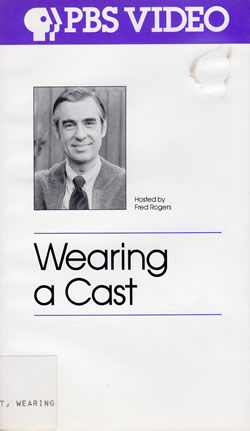
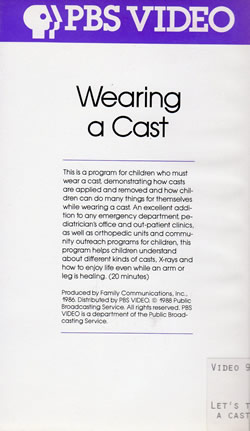
Produced by Family Communications, Inc., 1986. Distributed by PBS VIDEO.
©1988 Public Broadcasting Service.
Description
Original date: 1976
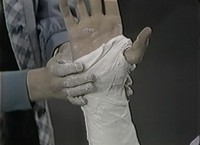
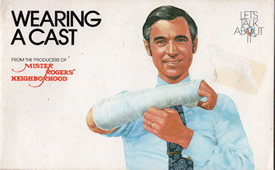
Arriving with a cast, Mister Rogers shows viewers how it once fit on his arm: "It's a strong, hard bandage." He explains that doctors sometimes use a cast on an injury to hold that part of the body very still and help it to heal. Mister Rogers reveals that he has never really needed a cast but he wanted to learn about them by having one put on his arm. He reflects on this experience by showing a clip from an episode from the Neighborhood program.
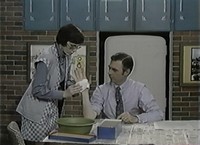
As Mister Rogers' doctor friend, Dr. Clark, explains the process, she applies a cast to his right forearm.
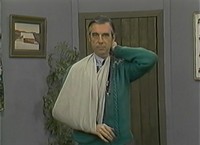
After watching the clip, Mister Rogers demonstrates a sling. Leaving no detail uncovered, Mister Rogers goes on to talk about how a person's skin often feels itchy under a cast.
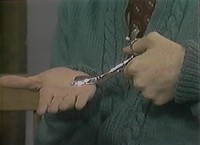
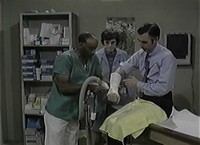
Going back to the video clip, Mister Rogers remembers going to the hospital to have his cast removed.
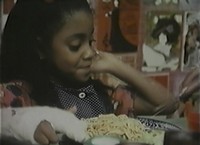
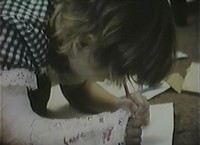
After this clip is finished, Mister Rogers talks about how children who are wearing casts can still do many things. He shows a short film of young people with casts on as they perform everyday tasks. The film is set to an instrumental of Children Can.
Mister Rogers reminds viewers that, unlike a broken toy, a broken bone can heal itself: "You're not a toy. You're a person. A very important person. Even if you need to wear a cast your body will keep on growing just as your feelings and ideas keep on growing everyday. People like you just the way you are. I'm glad that we could have this special visit together."
Guests
- Dr. Mary Williams Clark
Images


Notes
A supplemental book was published to go along with this video:
Episode 210b of Daniel Tiger's Neighborhood features a short live action segment where a boy has a cast applied to his arm.
Episode Credits
Supported by Johnson & Johnson Baby Products Company
McFeely-Rogers Foundation - Latrobe, PA
Produced by Family Communications
© 1976 Family Communications, Inc.
Produced in cooperation with the American Academy of Pediatrics, the American Hospital Association, and the American Medical Association